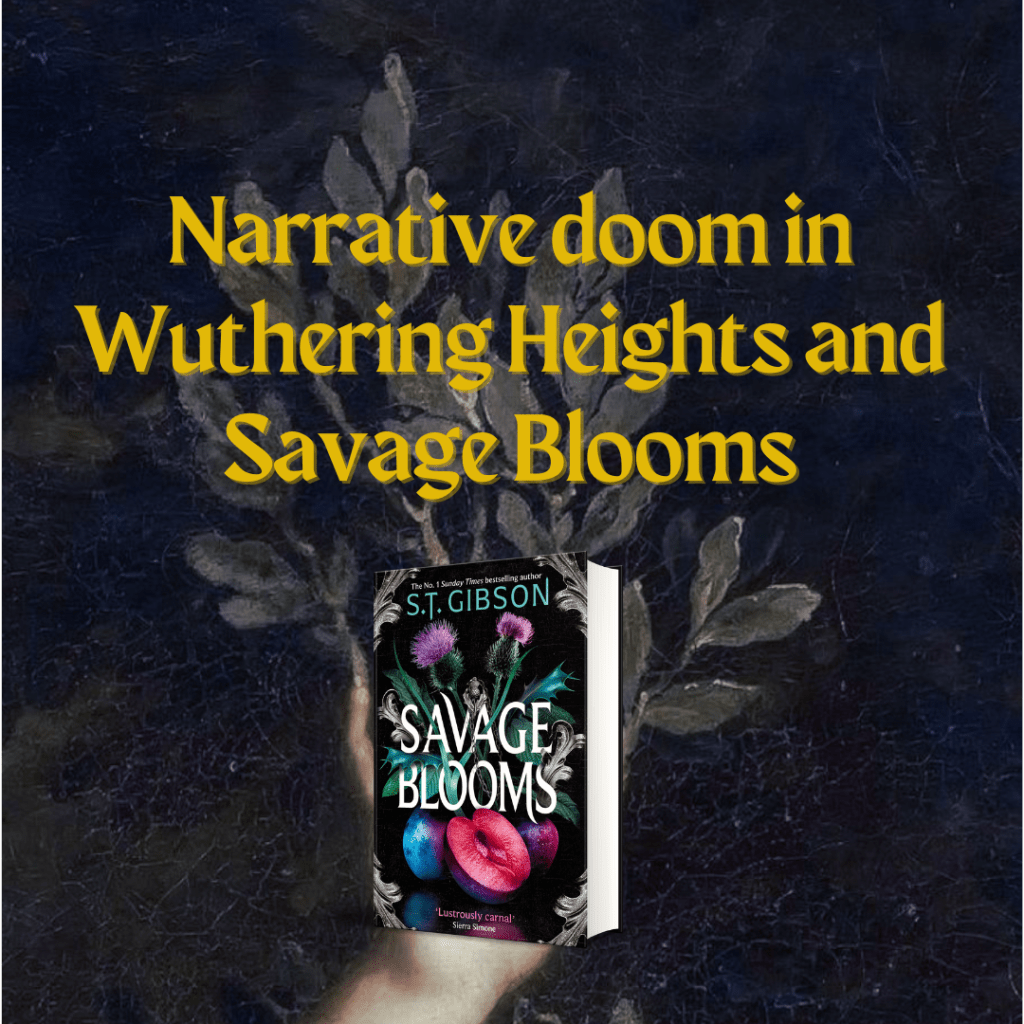
‘We only ever had each other’: Narrative Doom in Wuthering Heights and Savage Blooms by S. T. Gibson
Wuthering Heights stands heads and shoulders above most of my literary inspirations. Painfully poetic, lashed with wind and darkened by storms, claustrophobically tied to an almost-sentient stately home, and suffused with dangerous eroticism, it is in so many ways the ultimate gothic novel. What draws me back to the Heights over and over again is the masterful presentation of a generational trauma narrative, a story of the isolation, abuse, and psychosexual anguish that can only happen within the intimate confines of family. Wuthering Heights is many things: a love story, a family saga, a melodrama, but most of all it’s a story laboring beneath the oppressive, near-supernatural weight of an inherited cycle that feels like a curse.
A single question burns at the heart of the novel: if you only had one lifetime to break your family’s curse, could you do it, and what would it cost you? This is also the driving question behind Savage Blooms, the first book in my Unearthly Delights trilogy, and a Wuthering Heights homage inside and out.
It would be unfair to call Savage Blooms a Wuthering Heights retelling; it’s a high-heat folkloric romance about four doomed lovers fighting to escape a familial faery bargain. But Savage Blooms certainly rhymes with Wuthering Heights, it echoes its melodies and motifs. It’s a far-flung descendant of Bronte’s novel, a distant relation identifiable only by a fiery ancestral temperament, a shared pair of dark eyes, and an all-too-human defiance in the face of narrative doom. Readers who encounter Eileen and Finley should have the strange sense that they’ve met these people before in another life, on another moor, under another grey sky.
Eileen, high spirited to the point of capricious, aristocratic, and trapped by her circumstances just like Cathy. Finley, working class and limited by his station despite his intelligence and astute understanding of human desire which, like Heathcliff, he can use for good or ill. Even sweet, vivacious Adam and Nicola stand in for the Lintons, outsiders manipulated like game pieces on the board of Eileen and Finley’s lives.
Falling in love with Adam and Nicola, a love all the more tortuous for its earnestness, destroys the world of mind games and power plays that Finley and Eileen have hidden away in. As in Wuthering Heights, love is destabilizing; it’s an encounter with the sublime which threatens propriety, propriety, and inheritance. But love also offers Eileen and Finley a glimmer of hope that they might manage to free themselves from their own cycle before the cycle grinds them down completely. Like the only characters left standing at the end of Wuthering Heights, Finley and Eileen are the last of their lines, the inheritors of all their families’ sins – as well as a ruinous treaty with their fae neighbors.
Much of Wuthering Heights is spent chronicling the lives of Cathy and Healthcliff, a tragic pair of lovers whose love is not enough to save them. Their childhood affection is strangled by growing up in an abusive, racist household. It is corroded in adulthood by Cathy and Heathcliff’s evenly-matched cruelty, and of course, that altar to the small god of revenge which Heathcliff’s life becomes. Cathy and Heathcliff don’t break the cycle, they become the cycle, its ultimate and most brutal consummation.
The final generation of Earnshaws and Lintons, Hareton and Catherine, escape this cycle only narrowly at the eleventh hour of the novel, and even then, love is not enough. Their self-rescue demands not just tenderness but solidarity, cunning, bravery, and the willingness to fight back against their shared abuser no matter the cost.
When Finley observes that he and Eileen have ‘only ever had each other’, he’s rhyming with what Nelly says at the end of Wuthering Heights, when only Catherine and Hareton are left: ‘there’s no one else’.
Savage Blooms opens where Wuthering Heights closes, with the final generation left in the wake of abuse, lies, and revenge. Can Finley and Eileen escape the ouroboros of pain they have been born into, or will they devour themselves whole? Will they save each other, or will they succumb to the same curse that destroyed their forebears?
I suppose it’s cheating to pretend like I don’t know the answer: I’m the author after all. But the answer can only be reached by plunging into the darkest parts of us, by feeling our way towards the center of the labyrinth of the human heart. Solving that labyrinth step by step, not knowing whether you’re on the right path, is what births real magic, in fiction and in our lives. Every time I sit down to work on this series, I’m taking one more step in the dark, putting my faith in these two vibrant, violent people balanced on the knife’s edge of love and hate. It’s an audacious act of hope, trusting them.
It doesn’t matter what I know about the way the trilogy ends. What matters is that I believe Finley and Eileen can break their cycle, even on days when I am caught in inherited cycles of my own. In the process of writing, in navigating the labyrinth, I sometimes turn a blind corner and come face to face with the worst parts of my nature, or hit a wall built by the wounds I inherited at birth. But I know that if I follow Eileen and Finley’s voices, I will eventually find my way back onto the right path.
Sometimes, in the darkest and coldest parts of the labyrinth, I feel Eileen slipping her hand into mine and pulling me forward.
Whether Finley and Eileen are destined or doomed for each other matters little to me these days. Perhaps, in some ways, they have always been the same thing. Perhaps the only difference is how we choose to treat each other, and whether we choose to believe we cannot change or fight to find a new way forward.
For my part, what matters the most is descending just as deeply into the labyrinth for Finley and Eileen as they would for each other: my two headed hare, my Heathcliff and Cathy.
'A drizzly, moody, and lustrously carnal rendition of a storybook tale, Savage Blooms is the holy grail for lovers of dark academia and faery magic alike. By the time I got to the epilogue, I was ready to bite into the pages like they were made of faery fruit, just so I'd never have to leave' Sierra Simone, author of Priest
Inspired by Wuthering Heights, Savage Blooms is the sensational new gothic fantasy romance from internationally bestselling author S.T. Gibson, author of the cult phenomenon A Dowry of Blood.
For as long as Adam can remember, the legends passed down from his world-traveling grandfather have called him to a crumbling manor in the Highlands. His closest friend Nicola longs for the same adventure, as well as for Adam himself. She'll follow him just about anywhere -even to the remote wilds of Scotland-if it pushes the pair to surrender to their shared attraction.
But when a storm strikes and strands them unexpectedly, Adam and Nicola find themselves at the mercy of the eccentric owner of the infamous house, Eileen, as well as her brooding groundskeeper, Finley.
Trapped by the weather, and bound by ancient faery magic, Nicola and Adam get more than they bargained for as they become entangled in Eileen and Finley's world of mind games, deceit and forbidden desire. As ancestral sins are unearthed, Adam and Nicola will have to reckon with the spell Eileen and Finley have cast over them - and whether or not they even want to be free.
Praise for S.T. Gibson:
'With Savage Blooms, Gibson cements herself as one of the strongest and most unique voices in gothic romance. This dangerous and decadent subversion of a found family is fresh, unabashedly queer, and gripping from the very first rain-soaked page. Gibson is a ferociously talented writer at the top of her game' Sydney Shields, author of The Honey Witch
'A dark and sensuous gothic tale where jewelled prose and mysterious folklore fuse in a heady, intoxicating potion. Gibson is a master of seduction' Maddie Martinez, author of The Maiden and her Monster
'Weaving a lush tapestry that is at turns diabolically sexy and unbearably anguished, Gibson draws readers into this darkly decadent fairy tale where love is the most poisoned fruit of all. Savage Blooms is a portrait of an author at the top of her game, ushering in a new standard for gothic romance' K. M. Enright, author of Mistress of Lies
'Savage Blooms unfurls with languid, deliberate intent-lush, seductive, and laced with thorns. Every petal tempts and every page cuts in S. T. Gibson's darkly sensual-and yes, savage-modern fairy tale.' Lyra Selene, author of A Feather So Black
'A darkly decadent descent into desire. A masterful exploration of faerie bargains, ancestral burdens, and power struggles woven between the pages of a thrilling tale you can't help but be swept up in' Hazel McBride, author of A Fate Forged in Fire
Related Posts
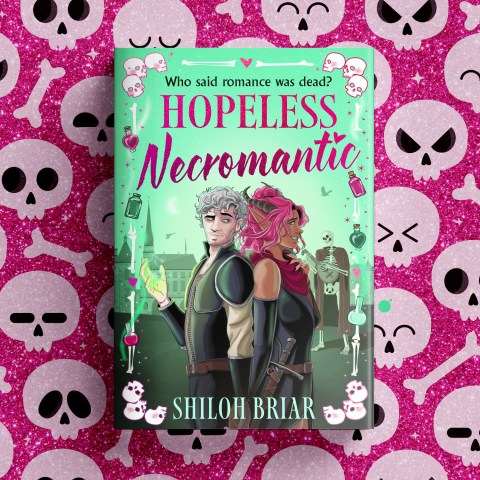
Read an extract of Hopeless Necromantic by Shiloh Briar
Acquisition Announcement: By Divine Rage by Roseanne A. Brown

Acquisition Announcement: Grave Empire by Richard Swan

Acquisition Announcement: The Outcast Mage by Annabel Campbell
Acquisition Announcement: Blood of the Old Kings by Sung-il Kim